The Economic Avalanche: Why Blue States Are Hemorrhaging Wealth While Red States Boom
Less than one year into President Trump's second term, an unprecedented economic shift is reshaping America. While mainstream media fixates on individual commodity prices, a massive demographic and economic avalanche is fundamentally transforming the nation's political and economic landscape.
The numbers tell a story Democrats desperately want to suppress: millions of Americans are abandoning high-tax blue states for low-tax red states, taking trillions in wealth with them. This isn't a temporary trend—it's a permanent realignment that will define American politics for decades.
The Inflation Reality Democrats Won't Acknowledge
Current economic data reveals a stark contrast between Biden's economic catastrophe and Trump's recovery. As of September 2025, inflation stands at 3%—a dramatic improvement from the 9.1% peak reached under Biden in June 2022, which represented a 40-year high.
More importantly, wages are now growing at 4.2%, creating real wage growth of approximately 1.5 to 2.5 percentage points above inflation. For the average American worker, this translates to $30 to $50 more per week in actual purchasing power—roughly $1,500 to $2,600 annually in real terms.
This marks the first sustained period of real wage growth since February 2024, fundamentally improving the financial position of working Americans.
The Beef Price Distraction
Democrats have seized on rising beef prices—up 14.7% year-over-year—as evidence of economic failure. What they conveniently omit is President Trump's proactive solution.
On November 20th, Trump signed an executive order removing the 40% tariff on Brazilian beef, coffee, and agricultural products. The order was backdated to November 13th, ensuring importers receive refunds for duties already paid. This tariff had been strategically imposed in July as leverage in trade negotiations with Brazilian President Lula da Silva.
The strategy worked exactly as designed: Trump secured concessions in negotiations, then removed the tariff to benefit American consumers. This is leadership through negotiation rather than perpetual complaint.
The Egg Story Democrats Forgot
Remember when Democrats spent months highlighting egg prices as proof of Trump's economic failure? In March 2025, eggs reached a record $6.23 per dozen, triggering daily media coverage about struggling families.
Fast forward to September 2025: egg prices dropped 4.7% month-over-month and have fallen for five consecutive months. Farm-level prices plummeted 22.8% from July to August alone. Year-over-year, September egg prices were down 1.3% compared to September 2024.
The administration solved the problem through strategic action:
- $1 billion investment in biosecurity measures to combat avian flu
- Increased imports from South Korea, Turkey, and Brazil
- Supply stabilization that brought prices down naturally
Once the problem was solved, Democrats simply moved on to their next complaint—beef—rather than acknowledge success.
Energy Independence Drives Economic Gains
Perhaps no metric better illustrates the red state advantage than gasoline prices. While Tennessee averages $2.60 per gallon (with some areas as low as $2.26), blue states paint a drastically different picture:
- California: $4.59 per gallon
- Hawaii: $4.44 per gallon
- Washington: $4.18 per gallon
The national average recently dropped below $3 for the first time since Trump's return to office. Crude oil trades at $59.44 per barrel due to increased domestic production under Trump's energy policies.
The policy difference is straightforward: red states embrace American energy independence through domestic production and pipeline infrastructure. Blue states regulate, tax, and mandate themselves into energy poverty through counterproductive "green" policies.

The Great American Exodus: Following the Money
Between 2020 and 2024, the demographic shift has been seismic:
Blue State Losses
- California: Lost 1,465,000 residents and nearly $25 billion in adjusted gross income in a single year
- New York: Lost 966,000 residents and $20 billion in income
- Illinois: Lost 418,000 residents
- Other exodus states: New Jersey, Massachusetts, Pennsylvania, Maryland, Louisiana, Virginia, Connecticut
Red State Gains
- Florida: Gained 872,000 residents and $36 billion in income
- Texas: Gained 747,000 residents and $12 billion in income
- Other growth states: North Carolina, Arizona, South Carolina, Tennessee, Georgia, Nevada, Idaho
Florida and Texas alone gained the population equivalent of West Virginia. More significantly, the migration patterns show a clear trend: high earners are fleeing blue states at the highest rates.
Among Americans earning over $200,000 annually, the exodus to low-tax states is even more pronounced. California lost over 360,000 residents to Texas, transferring nearly $21 billion in income between 2012 and 2022. New York lost over 380,000 residents and $37 billion in income to Florida during the same decade.
The Real Cost of Blue State Living
The economic calculation is straightforward. Consider a worker earning $60,000 annually who receives a 4% raise ($2,400):
California: 9.3% state income tax on that bracket costs $223 of the raise just to Sacramento Tennessee: Zero state income tax—keep every penny
But the disparity extends far beyond income taxes:
Housing Costs
- California median home: Over $700,000
- Tennessee median home: Around $300,000
- Same quality house, half the price
Energy Costs
- California gas: $4.59/gallon
- Tennessee gas: $2.60/gallon
- 15-gallon tank fill-up costs $30 more in California
Utility Costs
Americans now pay an average of $265 monthly for utilities, up 12% from last year. This burden is significantly higher in blue states implementing costly green energy mandates and regulations.
Grocery Costs
Food prices run higher in blue states due to excessive regulations and taxes on businesses.
The bottom line: The same quality of life—same house, same car, same food, same lifestyle—costs half as much (or less) in red states compared to blue states.
Political Consequences of the Exodus
This demographic shift carries profound political implications that extend far beyond economics. Population changes directly affect congressional representation and Electoral College votes through the decennial census.
The 2030 census is projected to be catastrophic for Democrats. Political analysts estimate Democrats could lose as many as 10 House seats purely from population shifts. States like California, New York, and Illinois will lose representation, while Texas, Florida, and North Carolina gain seats.
Critically, this doesn't only affect the House of Representatives—it fundamentally alters the Electoral College. Every congressional seat lost in a blue state means one fewer electoral vote. Every seat gained in a red state adds Republican electoral votes.
Democrats face a structural disadvantage that will persist for decades because migration patterns are permanent. Once people relocate, they rarely move back. Once businesses establish operations in red states, they don't return to blue states.
The Family Flight: Young Producers Leaving Blue States
According to the Institute for Family Studies, blue states lost 213,000 families with children in 2021 and 2022 alone. California shed 92,000 families with kids—young families in their prime earning years who represent future taxpayers and economic productivity.
These aren't random departures. The exodus is most pronounced among high earners and business owners—the wealth creators and job generators who pay the bulk of state taxes. As they leave, blue states face collapsing tax bases and declining revenues.
The Blue State Death Spiral
Democratic governors are responding to declining revenues in the worst possible way: raising taxes even higher.
Maryland provides a perfect case study:
- Republican Governor Larry Hogan cut taxes by $4.7 billion over eight years
- Under Hogan, Maryland's economy improved from 49th to 6th nationally
- Business boomed, people moved in, revenue increased despite lower tax rates
- New Democratic Governor Wes Moore immediately raised income taxes on residents earning over $500,000
- Result: More people left, revenue projections missed, Maryland returned to economic decline
The pattern repeats across New York, Illinois, and New Jersey:
- High taxes drive people and businesses away
- Lost revenue creates budget shortfalls
- Democrats raise taxes higher to compensate
- Even more people and businesses leave
- Tax base shrinks further
- Services deteriorate, crime increases, schools fail
- The cycle accelerates
The Red State Virtuous Cycle
Republican governors understand the opposite approach works. Virginia Governor Glenn Youngkin explained the dynamic perfectly: "Those people are going to bring with them their income, and they are going to pay taxes, and then we have a surplus, and with that surplus we get to invest in education and law enforcement and behavioral health, and we get to reduce taxes again."
The red state model creates a virtuous cycle:
- Cut taxes to attract people and businesses
- Larger tax base generates more revenue even at lower rates
- Revenue surplus allows investment in services and infrastructure
- Further tax cuts become possible
- More people and businesses relocate
- Growth compounds on growth
The blue state model creates a vicious cycle:
- Raise taxes to close budget gaps
- Drives away people and businesses
- Shrinks tax base
- Creates larger budget deficits
- Leads to additional tax increases
- Decline compounds on decline
Real Wage Growth: The Proof Trump's Economy Works
From July 2024 to July 2025, nominal wages grew 4.2% while inflation ran at 2.7%. This created real wage growth of 1.5 percentage points above inflation—meaning workers gained purchasing power every single month.
Compare this to Biden's economy in 2022, when inflation hit 9% while wage growth reached only 5%. Workers lost ground monthly as their purchasing power was systematically destroyed.
Under Trump, the average worker gains $30 to $50 weekly in real purchasing power. This happens simultaneously with:
- Falling gas prices
- Declining egg prices
- Active negotiation to reduce beef prices
- Increased energy independence
According to the Conference Board, employers plan average salary increases of 3.9% for 2025, with some industries exceeding 4%. Insurance, energy, agriculture, and communications sectors all project raises above 4%.
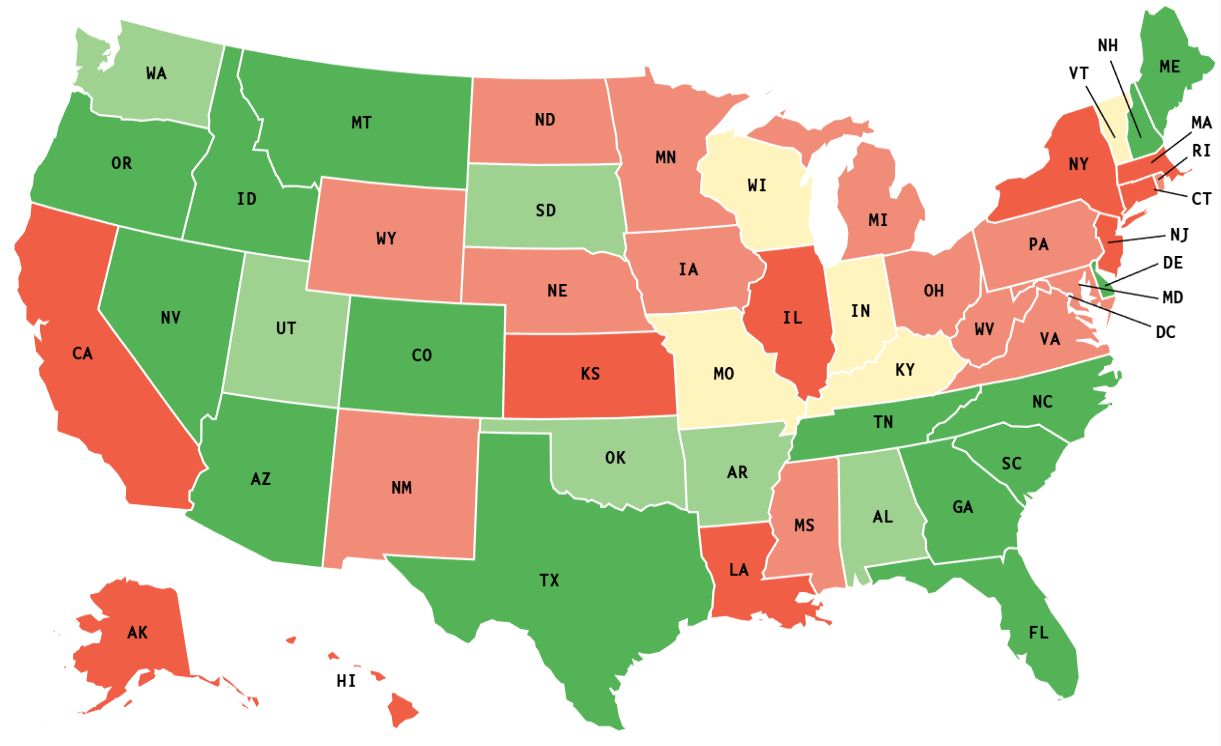
The Nonprofit Unleash Prosperity created an interactive tool at VoteWithYourFeet.net that tracks migration patterns in real-time. Their economist Stephen Moore captured the significance: "This is the most significant economic and demographic trend happening in America today, and it's not slowing down. It's still accelerating."
What This Means for America's Future
The economic avalanche represents more than temporary population shifts or short-term political advantages. This is a fundamental realignment of American political geography with consequences extending decades into the future.
Blue states built economic models on high taxation, extensive regulation, and progressive social policies. The model worked when geographic mobility was limited and information asymmetry prevented easy comparison. The internet and remote work destroyed both constraints.
Americans can now:
- Research cost-of-living differences instantly
- Work remotely from any location
- Compare tax rates, housing costs, and quality of life metrics in real-time
- Relocate with unprecedented ease
The verdict is clear: Americans overwhelmingly choose freedom over government control, opportunity over redistribution, and low taxes over expansive social programs.
Democrats can scream about beef prices while ignoring Trump's active solution. They can memory-hole their egg price complaints once Trump solved the problem. They can pretend inflation isn't down from Biden's catastrophic 9.1% peak.
But they cannot stop the exodus. They cannot prevent the demographic realignment. They cannot reverse the economic avalanche that's burying their political model.
The Bottom Line
Consider the economic reality facing average Americans:
Under Biden: 9.1% inflation, negative real wage growth, $5+ gas, families choosing between fuel and food
Under Trump (Less Than One Year):
- 3% inflation (down from 9.1%)
- 4.2% wage growth (beating inflation)
- $3 gas nationally, $2.60 in red states
- Egg prices falling for five consecutive months
- Active negotiation to reduce beef prices
- Real purchasing power gains of $1,500-$2,600 annually
Blue State Exodus:
- California: $25 billion in income lost
- New York: $20 billion in income lost
- Illinois, New Jersey, Massachusetts: Massive population declines
Red State Boom:
- Florida: $36 billion in income gained
- Texas: $12 billion in income gained
- Tennessee, Georgia, Carolinas: Major population growth
This isn't spin. This isn't narrative. This is objective economic data showing the fundamental transformation of American economic geography.
The economic avalanche is real. It's accelerating. And it's permanently reshaping America's political landscape.
Americans are voting with their feet—and their wallets. They're choosing red state freedom over blue state failure. They're selecting opportunity over regulation, low taxes over high taxes, economic growth over government expansion.
Democrats can complain all they want. The American people are living the real story.
John O'Connor is a software programmer and host of O'Connor's Right Stand podcast, delivering deep conservative analysis every Tuesday and Thursday. Follow him on X @OConnorPodcasts or visit OConnorsRightStand.com for more episodes.

Trump's Historic Pharmaceutical Victory: 14 Companies Slash Drug Prices While Insurance Giants Face Reckoning