Australia's Gun Ban Failed: What the Bondi Beach Massacre Reveals About Disarming Citizens
When Australia banned firearms in 1996, gun control advocates worldwide celebrated it as the model every nation should follow. Politicians promised that removing guns from society would end mass violence and create a safer country. Nearly three decades later, the results tell a very different story—one the mainstream media refuses to acknowledge.
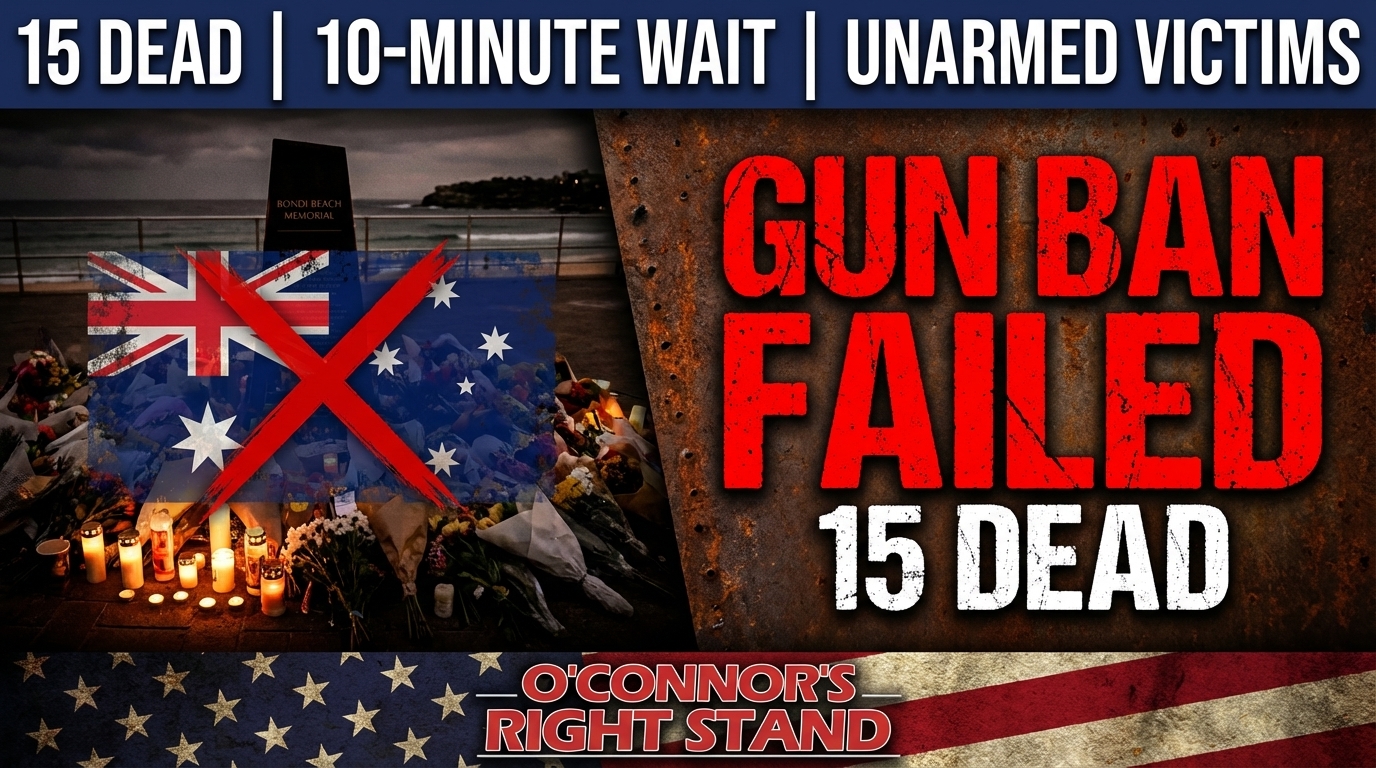
On December 14, 2025, two Islamic terrorists opened fire on over 1,000 Jewish families celebrating Hanukkah at Bondi Beach in Sydney. Fifteen people died. Forty-three were wounded, ranging in age from 10 to 87. For ten minutes, the shooters fired over 100 rounds into defenseless crowds while a police detective took cover behind a tree. The massacre only ended when two unarmed refugees charged the terrorists with their bare hands.
This attack exposes the fundamental lie behind gun control: disarming law-abiding citizens doesn't stop criminals or terrorists. It just ensures victims die waiting for help that arrives too late.
The Promise That Failed: Australia's 1996 Gun Ban
The Port Arthur massacre on April 28, 1996, changed Australia forever. A man with no criminal record walked into a cafe in Tasmania carrying semi-automatic rifles and murdered 35 people in Australia's deadliest mass shooting. The government's response was swift and severe.
Within months, Australia passed the National Firearms Agreement, which banned all semi-automatic rifles and semi-automatic or pump-action shotguns. The government implemented strict licensing requirements, mandatory safety courses, and comprehensive registration databases. Then came what they euphemistically called the "Gun Buyback Program"—though calling it a "buyback" when the government never sold you the guns in the first place is Orwellian doublespeak for forced confiscation with compensation.
Between 1996 and 1997, Australians surrendered approximately 660,000 firearms. The promise was simple: remove guns from society, end mass shootings, reduce violent crime, and make Australia safer. Gun control advocates still point to Australia as proof that strict gun laws work.
But the data tells a different story.
Violence Didn't Disappear—It Just Changed Weapons
According to the Australian Institute of Criminology, in the five years before the 1996 gun ban, knife homicides accounted for 34% of all homicides in Australia. In the five years ending in 2021—the most recent data available—knife homicides accounted for 43% of all homicides.
Read that again. After banning guns, the percentage of people murdered with knives increased from 34% to 43%. In 2007 and 2008, knives were involved in 43% of all Australian homicides. By comparison, in 2000—just four years after the gun ban—knives only accounted for 30% of homicides.
What does this data reveal? Evil doesn't need a gun. Evil finds a way.
Gun control advocates will point to Australia's declining overall crime rate since 2009 as evidence their policies worked. But that decline started more than a decade after the gun ban and mirrors a global phenomenon criminologists call "the great crime drop." Violent crime fell across developed nations from the 1990s through the 2000s—in countries with strict gun control and countries without it. America experienced the same crime drop while gun ownership increased dramatically.
When Australian politicians claim their gun ban reduced violence, they're taking credit for a worldwide trend that had nothing to do with their policies. What the gun ban did accomplish was stripping law-abiding Australians of their ability to defend themselves.
Ten Minutes of Terror While Police Take Cover
The Bondi Beach massacre unfolded with horrifying clarity. At 6:45 PM local time on December 14th, over a thousand people gathered at Archer Park near Bondi Beach for "Hanukkah by the Sea." Families enjoyed donuts, children climbed a rock wall, and people danced to celebrate the first night of Hanukkah.
At 6:47 PM, two men dressed in black stood on a pedestrian footbridge overlooking the park and opened fire with a bolt-action rifle and a shotgun. Witnesses described ten minutes of sustained gunfire—over 100 rounds fired into the crowd. People ran, screamed, and hid under cars. Parents covered their children with their own bodies.
One father hiding under a vehicle with his wife and four children yelled during a TV interview: "They were shooting for 10 minutes. Where were the police? Where was the help?"
Ten minutes. This man lay under a car watching people murdered around him, his infant in his arms, his 2-year-old and 11-year-old terrified beside him, not knowing where his 14-year-old son was—and nobody with a gun could stop it. Why? Because Australia banned guns. Law-abiding citizens had no way to fight back. They could only run or hide.
But here's where the story becomes even more disturbing. According to CNN's reporting, a police detective was on the scene—taking cover behind a pine tree on the footbridge while terrorists fired into the crowd below. For ten minutes, those terrorists had free rein to murder families while a police officer with a gun remained behind cover.
Unarmed Refugees Stopped the Massacre, Not Police
What finally ended the massacre? Not police response. Civilians.
Ahmed Al Ahmed, a 43-year-old Syrian refugee and fruit shop owner, tackled one of the shooters unarmed. He wrestled the rifle away from the terrorist and was shot four or five times in the shoulder during the struggle. His heroism saved countless lives.
Then there's another hero the media largely ignored—a Middle Eastern refugee identified only as "AB" by his lawyer. AB is a father of two whose wife is pregnant, and he doesn't even have permanent legal status in Australia yet. When his taxi arrived at Bondi Beach and he heard gunshots, AB ran toward the gunfire.
His lawyer told CNN: "He comes from a country where you know when there is gunfire. He just knew he needed to run towards it to help stop it."
AB made his way to the footbridge and took cover behind the same pine tree as the detective. When police finally shot one of the terrorists, AB ran up the stairs while the shooter was still holding his gun and kicked the weapon away with his bare hands. Police nearly shot AB because they didn't know if the shooter was neutralized and confused him for one of the terrorists.
Two unarmed refugees saved lives that day while a detective with a gun hid behind a tree. Two officers were shot during the attack and are in serious condition—these men and women put their lives on the line. But the system itself is broken. The rules of engagement that put police in a position where they take cover while civilians charge shooters with bare hands represent a catastrophic failure of policy.
Police Hamstrung by Bureaucratic Rules of Engagement
Why didn't police immediately engage active shooters firing into a crowd? Australian police use-of-force policies provide insight into this deadly hesitation.
In New South Wales, police can only use firearms when there is an "immediate threat to life or serious injury." They must justify force as "reasonable, necessary, proportionate, and appropriate." Officers must engage in "dynamic risk assessment"—they must assess and reassess situations constantly. Firearms are considered a last resort after all other non-lethal methods.
When two terrorists fire between 50 and over 100 rounds into families celebrating a religious holiday, what exactly needs to be assessed? What non-lethal methods should officers try first when someone is actively committing mass murder?
Australia did pass a law in 2017 allowing NSW police to use lethal force against suspected terrorists even without an imminent threat—specifically designed for terrorism scenarios. But clearly something went catastrophically wrong because a detective was taking cover on that footbridge while unarmed refugees charged the terrorists.
Australian police appear so hamstrung by bureaucracy, so terrified of using their firearms, so worried about being second-guessed and prosecuted, that even during an active terror attack, they hesitate.
Compare that to American police doctrine. When there's an active shooter, our response is simple: run toward the gunfire, engage immediately, stop the threat. Period. We learned that lesson after Columbine. We don't wait. We don't hide behind trees while people die. And American armed civilians will do the same thing because we have the Second Amendment and believe in the fundamental right to self-defense.
If just one armed civilian with a concealed carry permit and proper training had been in that crowd at Bondi Beach, how many of those 15 victims would still be alive?
The Data Gun Control Advocates Ignore
The Centers for Disease Control and Prevention estimates defensive gun use happens between 500,000 and three million times per year in the United States. There are thousands of documented cases of armed citizens stopping mass shooters before police arrive.
But in Australia, citizens were defenseless. Police were hamstrung by bureaucratic rules. And 15 people paid with their lives.
Gun control advocates don't want Americans to know that violence didn't stop after Australia banned guns—it just changed tactics. Australia has experienced multiple high-profile mass violence incidents in recent years:
- April 2024: A mentally ill man with a knife killed six people at Bondi Junction Shopping Center before police finally shot him
- Same month: A teenage boy stormed a Christian church service and stabbed a priest mid-sermon, wounding multiple bystanders in what was declared terrorism
- 2019: A stabbing murder in Queensland led to "Jack's Law," legislation further restricting knife possession
The pattern is undeniable. When you ban guns, terrorists and criminals adapt. They use knives. They use vehicles. Remember the 2017 Westminster Bridge attack in London when a terrorist used a car to kill five people and injure 50 others? Evil finds a way.
You cannot easily defend yourself against a knife-wielding attacker with your bare hands. You cannot defend yourself against a vehicle ramming into a crowd. You cannot defend yourself against acid attacks, which have skyrocketed in the United Kingdom since their gun ban.
But you can defend yourself if you have the great equalizer—a firearm. That's why it's called the equalizer. A 100-pound woman with a gun has the same defensive capability as a 250-pound male attacker. Take that away, and who wins? The strongest, the most violent, the predators.
The Blueprint Gun Control Advocates Want for America
This isn't just about Australia. Every time there's a mass shooting in the United States, the immediate response from the left is: "We need to be like Australia and ban the guns."
They don't tell you about rising knife crime. They don't tell you about ten-minute response times while terrorists slaughter families. They don't tell you about defenseless victims. They just say, "Turn in your guns and the government will keep you safe."
But government cannot keep you safe—not in real time, not when seconds matter and police are minutes away. The average police response time in America is ten minutes. In rural areas, it can be 30 minutes or more. When someone breaks into your home at 3 AM, when someone attacks you in a parking lot, when a mass shooter opens fire, you are your own first responder. If you're unarmed, you're a victim waiting to happen.
That's why the Second Amendment exists—not for hunting, not for sport shooting, but for defense against criminals, terrorists, and yes, tyranny. Our Founding Fathers understood something modern gun control advocates refuse to acknowledge: an armed population is a free population.
States With Concealed Carry Have Lower Mass Shooting Deaths
The evidence supports what common sense suggests. In America, states with the highest rates of concealed carry permits have lower rates of mass shooting deaths. Armed citizens stop crimes every single day. We don't wait ten minutes for help. We are the help.
This doesn't mean America's system is perfect or that Australia should return to 1995. But what it does mean is undeniable: when governments take away citizens' ability to defend themselves and promise safety they cannot deliver, innocent people pay the price.
Fifteen people died at Bondi Beach because their government disarmed them. Parents watched their children die. Families were slaughtered. And the only thing that stopped the massacre was two unarmed refugees charging terrorists with their bare hands while a police detective took cover behind a tree.
The Second Amendment Protects What Government Cannot
The Second Amendment isn't about hunting or sport. It's about the fundamental human right to self-defense. It's about understanding that government cannot be everywhere, cannot protect everyone in real time, and that citizens have both the right and responsibility to protect themselves, their families, and their communities.
When politicians tell you we need to be more like Australia, ask them: Do you want Americans waiting ten minutes while terrorists slaughter families? Do you want knife crime to replace gun crime? Do you want to strip away our constitutional right to self-defense based on promises that history proves are lies?
Because that's what they're really asking for.
The truth about Australia's gun ban is being exposed—not by politicians or media, but by the bodies left behind at Bondi Beach. Gun control doesn't stop evil. It just disarms the good. And when the shooting starts, victims die waiting for help that arrives too late.
This analysis is based on the December 2025 episode of O'Connor's Right Stand. For more in-depth conservative commentary on politics, policy, and culture, subscribe to the podcast on your preferred platform or visit OConnorsRightStand.com.

Trump's Historic Pharmaceutical Victory: 14 Companies Slash Drug Prices While Insurance Giants Face Reckoning